Discussing cross-border business at the barbecue table
Szczecin is the heart of the Polish-German region and together, we can show its potential to the world,” says Torsten Haasch, the chairman of IHK Neubrandenburg business chamber.
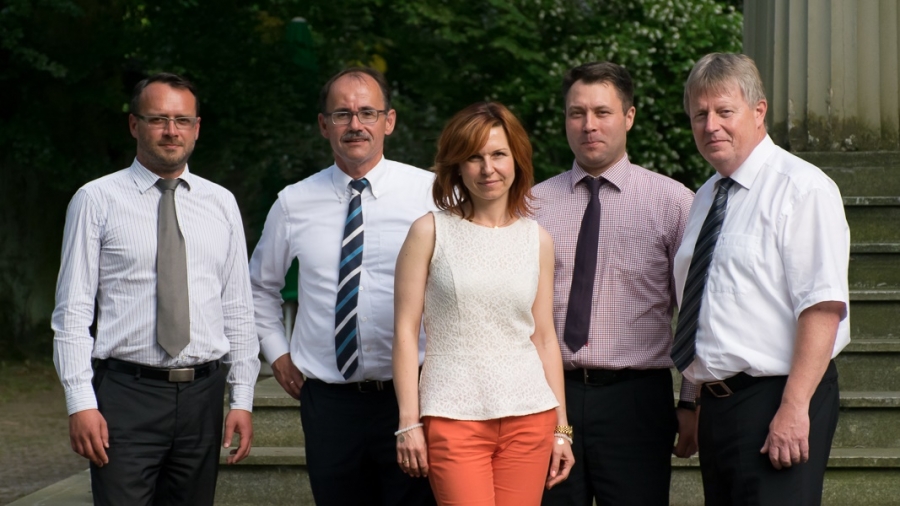 Adam Grendziak (Dom Gospodarki), Wolfgang Blank (prezydent IHK Neubrandenburg), Małgorzata Stopa, Krystian Stopa (Dom Gospodarki), Torsten Haasch (the chairman of IHK Neubrandenburg)
/fot.: mab /
Adam Grendziak (Dom Gospodarki), Wolfgang Blank (prezydent IHK Neubrandenburg), Małgorzata Stopa, Krystian Stopa (Dom Gospodarki), Torsten Haasch (the chairman of IHK Neubrandenburg)
/fot.: mab /
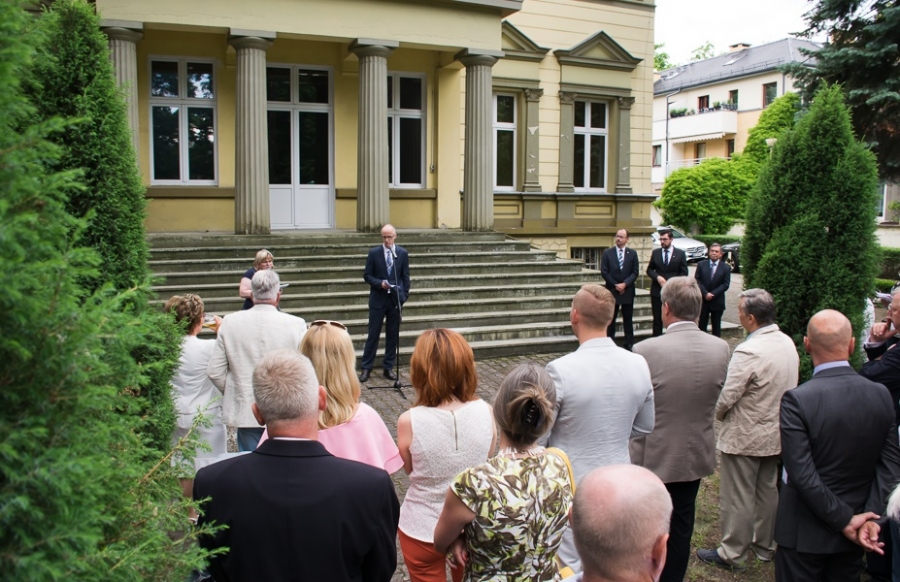
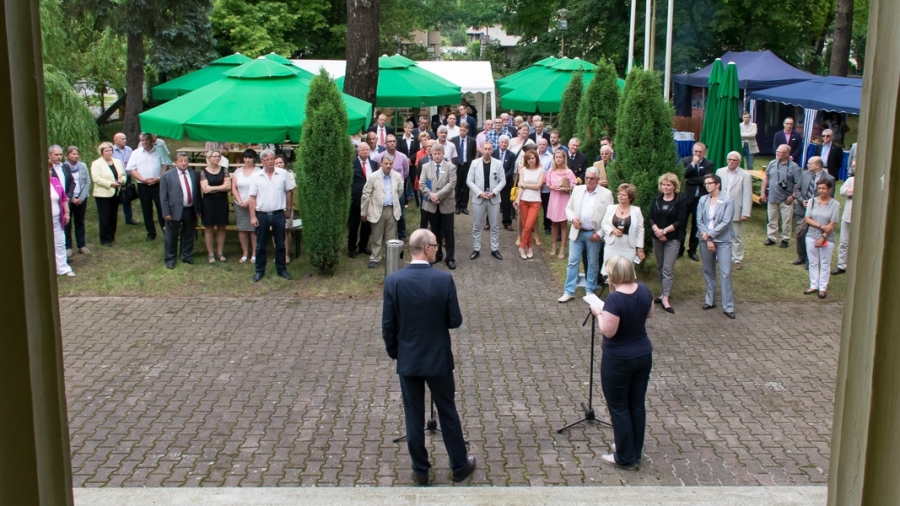
A meeting of Polish and German entrepreneurs (with barbecued sausages and beer on the menu) was organized by Dom Gospodarki – an organization run by IHK Neubrandenburg to assist in contacts between Polish and German entrepreneurs. The event was held in the garden of Dom Gospodarki house - a villa at al. Wojska Polskiego in Szczecin, on 22 June 2016. It was the last event of that kind hosted at that address - in August the institution will move to the building at ul. Marii Skłodowskiej-Curie in which the honorary consul of Germany in Szczecin is now located.
During the meeting Szczecinbiznes talked about business contacts between Poland and Germany with Torsten Haasch, the chairman of IHK Neubrandenburg.
Szczecinbiznes.pl: Dom Gospodarki at al. Wojska Polskiego has been operating for 15 years. What would you like to say to sum up this period of Polish and German business cooperation?
Torsten Haasch, the chairman of IHK Neubrandenburg: Dom Gospodarki was established in 2000 when the German government decided to close the general consulate in Szczecin. In order not to break off the German-Polish relations and to support the economic development of the region, the chamber of commerce and industry in Neubrandenburg together with its Polish partners decided to open Dom Gospodarki in Szczecin.
These past 15 years were very interesting and full of challenges. We have learned quite a lot. At first we focused on acquiring cross-cultural competence – we got to know the customs of the neighbours and the methods they used. Today we can talk openly with our Polish partners, we have confidence and we know each other very well. I think we could say that we have become good friends.
Just like our Polish partners, we believe that Szczecin lies at the heart of the Polish and German region and that the development of its metropolitan area is of key importance for the German side too. There are about 200 German companies from Mecklemburg in West Pomerania, so business contacts with Poland are crucial for the entrepreneurs operating in that region.
Could you give us some specific examples of such contacts?
The annual presentations – West Pomerania presents itself in Mecklemburg, and Mecklemburg in West Pomerania – are good examples of our cooperation. The meetings are initiated by both local governments and the entrepreneurs themselves.
Several months ago a contract was signed by Klaster Kreatywny operating at the Northern Chamber of Commerce and the Association of Creative Companies seated in Mecklenburg-Vorpommern. The parties are now in the process of negotiating joint projects, such as cooperation in organizing fairs.
Our last Wirtschaftskreis meeting was focused on Polish–German cooperation in maritime industry. Three shipyards in Mecklemburg (in Wismar, Rostock and Stralsund) have been taken over from their Russian owner by a new Milesian investor – the Genting Group that plans to build large river-faring vessels and cruise ships there. We have heard from the representative of the Maritime Cluster that the ship building industry Szczecin currently undergoes a revival. Considering that this sector is crucial for both our regions, we would like the cooperation between the shipyards and their subcontractors to intensify, and Dom Gospodarki in Szczecin should serve as a platform for initiating contacts in this sphere.
Yachtech of Greifswald is the second largest yacht producer in the world employing 830 staff locally and 400 - in Goleniowski Industrial Park - it would not be possible without the Schengen zone, open borders and free trading.
Another example is the business of Chefs Culinar - a wholesale foodstuff, catering and hotel supplier. At first Chefs Culinar made its supplies from the territory of Germany, but now the company has its own entity located in Szczecin at ul. Goleniowska. Dom Gospodarki served as the first contact point for the business, we assisted the company in searching out the relevant market information.
There are many other examples.
What kind of obstacles in development of cooperation do you need to deal with? What calls for improvement?
One may talk about slightly different mind-sets of our nations. Another hurdle is poor knowledge of each other’s languages.
The Zachodniopomorskie Region and Mecklemburg are not the richest areas as compared with the rest of their respective countries. How does it translate into their cooperation?
Both regions have advanced over the recent years in terms of business and trade. The economic growth of Mecklemburg is higher than the German average and better than in other northern lands of the former DDR. The fact that companies operating in Mecklemburg have difficulties with finding qualified workers rather than with financing their projects or the political considerations only proves that the region is faring well.
The Zachodniopomorskie Region and Mecklemburg are similar in many respects, even though in Germany there is no counterpart of Szczecin in terms of city size. And this is another reason why the Germans believe the Szczecin metropolitan area and contacts with Polish partners to be so significant. By way of illustration, if an investor engaged in Mecklemburg needs a container terminal, they must use the facilities located in Świnoujście or in Szczecin. As a consequence, we should cooperate to make Pomerania Eurorgion competitive with other regions.
Being the representative of the region, IHK often travels abroad. We have contacts with Brazilian, Cuban and Scandinavian entrepreneurs. I believe it is a good idea to join forces with the Polish side and together promote our potential. Our thinking needs to go beyond borders, but this attitude requires working on the assumption that the ideas of European unity and cooperation are still broadly endorsed.
What are your plans and goals for this year and for the future?
After 15 years of its existence, Dom Gospodarki has solid foundations in Szczecin. Both our Polish partners and we believe that this good work needs to be continued. We also want to find new partners for our projects, primarily on the Polish side, but we do not necessarily expect them to provide financial support for the projects. Generally, we are looking for organizations that want to support the development of Polish – German relations. Maritime industry is among our common areas for development.
What is more, infrastructure – roads, railways and flight connections - need to be improved and extended. Our respective spatial plans should be integrated. In Germany we are now in the process of creating infrastructural programme for the period up to 2030. In this connection IHK has made many suggestions to the authorities concerning combining the German infrastructure with the Polish one – for instance we postulated better connection with the island of Uznam, extension of the railway lines between Lubeka and Szczecin and the Heringsdorf airport which could also serve as the local airport for Świnoujście.
Another issue to resolve is clearing the Odra river. There is a Union of the Łaba/Odra rivers chamber co-founded by the Czech Republic, Germany and Poland. The Northern Chamber of Commerce, IHK from Neubrandenburg and IHK from Hamburg are active there.
However, our primary goal is to strengthen the Szczecin metropolitan area, because a strong metropolis will give Pomerania Euroregion a kick start. Mecklemburg has 1.2 million inhabitants, so there must be many partners willing to cooperate with us.
Interviewed by Michał Abkowicz
Co-operator: ak
Wszystkich rekordów: