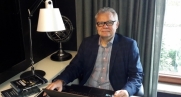
Ambitious music can sell well, too
 Dariusz Startek /fot. ŁP/
Szczecinbiznes.pl: Was the establishment of a company organising concerts a realisation of your dreams or a business idea?
Dariusz Startek: For many years music had been nothing more than a passion for me and I didn’t at all imagine I could combine it with work and make a living out of it. Like in many situations, it all began as a result of a coincidence. After I graduated from university with a degree in economics, I started working in my profession. But when the first opportunity arose, I decided to leave and started working for the Gazeta Wyborcza daily, where I spent the next six years. In that work I had a chance to go to even more concerts and events of all types, which I loved. As a result, an acquaintance of mine, who had run the Pinocchio cinema, suggested that I take charge of a cycle of concerts and become a sort of a curator. It took him a long time to persuade me, but when he finally did, things went smoothly thereafter.
How come your ‘after hours’ hobby of organising concerts became full-time employment?
That’s true. At the very beginning my collaboration with Pinocchio was quite loose and in the mean time I carried on with my other assignments. But as time went by, as the number of concerts we’d organised increased and as we were more and more successful, other clubs from all over the country started coming to us, asking us how to sign this or that artist or how to organise this or that event at their venues. Then I thought that could become my main area of activity and that perhaps I could open up a company. And that’s exactly what I did. At the beginning, I provided my services mainly to Pinocchio. Later, I began to receive proposals from outside and new opportunities were beginning to appear. Of course my objective still was to continue with the organisation of more and more concerts, so that I could make a living out of that alone. I managed to achieve that after a while, although there was a period when my earnings were well below the country average.
Those must have been good times for that type of business in Poland...
The early 1990s were indeed a breakthrough on the concert and club scene in this country. Before then, the scene had been dominated by Polish artists. And suddenly, it turned out that inviting a foreign artist, who had just been gigging, say, in Berlin, wasn’t such a big problem anymore. The costs were not so much higher, so we began doing that more and more often.
How do you go about bringing a world-famous artist to perform in Szczecin?
First of all you have to develop good contacts in the so-called ‘wide world’. The process is very simple: you begin from hiring someone cheaper, perhaps less known, nevertheless a good artist. Our appetites grew each time we managed to organise a good concert. But we also gained the recognition of agents, who would notice that we could handle some ‘lesser stars’, so they started coming to us with some more famous and expensive ones. That’s how it all works.
When choosing an artist, do you often have to make artistic compromises for the fear of poor ticket sales?
Personally, I’ve always wanted to play unconventional music, but I’ve also been aware that I cannot play complete avant-garde all the time, because I have to remember about my audience’s taste. But then it turned out that some of those avant-garde offerings did enjoy a wider public and that they could sell well, too. In general, it isn’t true that ambitious stuff will never sell and that you always have to come to compromises to survive. I am the best proof of that, because at the moment, I can’t complain about my income. I called my first business Impresariat Oprócz (Music Management Except) – meaning, I would do anything except trash. And I believe I can say that I’ve remained true to that. Also, the change in the type of music that dominates my work is not a result of compromises, but an organic growth.
And you have never turned down an artist thinking that he or she was too niche and simply nobody would come to their concert?
I think about ticket sales all the time, but I’ve never given up on anyone I really cared for only on account of the issue of ticket sales although I know that I can’t afford to have five such concerts within one cycle. Every festival needs a star, a dead cert who will deliver even if everything else goes wrong.
How do you calculate costs when you organise a concert for a foreign star in Szczecin?
It’s a very specific type of a business plan, because it depends on so many variables. First of all, it’s very hard to estimate the audience numbers. Sometimes a seemingly small error of let’s say 10 or 20 per cent constitutes our whole profit margin. As far as costs are concerned, frankly, it’s often quite impossible to get a grip on them. Sometimes costs will start accumulating after a concert has already ended, because you have to provide another car for the artists. Even though we are always prepared for many variables, ultimately, when you organise many concerts, everything balances out in the end: you will make money on some events and lose on others. Certainly the smaller the scale of your operations the higher the cash flow risk.
How expensive are the stars who will be performing at the Szczecin Plus Music Fest?
Their fees range from several thousand to several dozen thousand euros, and some charge even up to a hundred thousand euros. You have to add the cost of international travel to that, which can amount to several thousand zlotys. Cesaria Evora’s crew for example comprises 15 people, two of whom travel only business class. But such balance does not always provide you with a full picture, because those individual cost items are different for every concert.
Have you ever had a spectacular financial flop?
I wouldn’t call them spectacular flops, though I’ve had concerts when we thought at least a thousand people would come and less than half of that showed up on the night. But a loss on a single concert can really hurt if it is your only concert. Although in that particular case there were some other gigs as part of the same cycle and they sold much better than we’d anticipated. You will always have ups and downs; some years are better, some are worse, but all in all we’ve continued to grow.
How many people work with you?
The company employs three people, including myself. But you have to add a whole group of external collaborators, for example people responsible for the sound, light, flyers and posters. We also have external managers who travel with artists touring Poland. We all have a lot of work – last year we organised about 100 concerts around Poland.
Łucja Pawłowska